Published by the AcademicZed Editorial & Research Team | Verified for 2026 Admissions
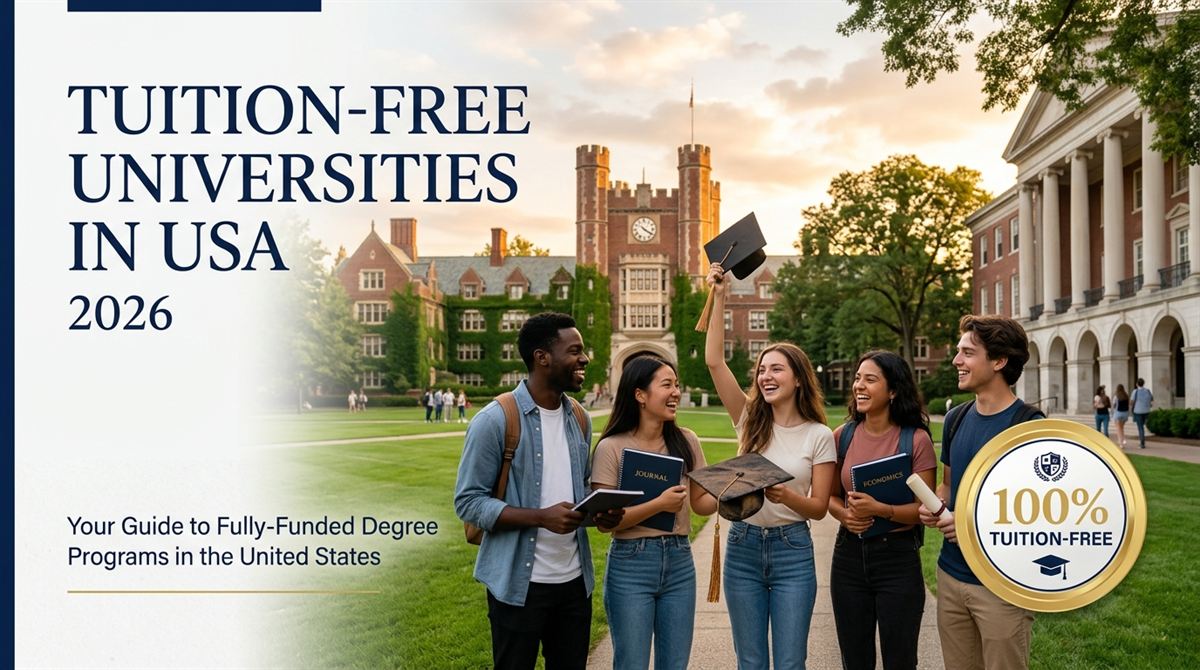
While the average cost of attending a four-year American university exceeds $45,000 annually for non-resident scholars, a select group of accredited American institutions operate on a zero-tuition model. Through massive endowment support, specialized work-college partnerships, or dedicated philanthropic foundations, these colleges guarantee that 100 percent of admitted international students pay zero tuition fees across all four years of their undergraduate degree.
Table of Contents
Key Takeaways from the AcademicZed Scholarship Intelligence Desk
- The Work College Model: Institutions like Berea College and College of the Ozarks cover full tuition in exchange for 10 to 15 hours per week of student-managed campus work, perfectly complying with federal F-1 on-campus employment limits.
- 100% Tuition Coverage: At Berea College, every single enrolled international student receives the No-Tuition Promise Scholarship worth more than $50,000 per academic year.
- Living Overhead Still Applies: While tuition is $0, international scholars must demonstrate sufficient funds for health insurance, SEVIS fees, travel, and personal incidentals (typically $2,000 to $4,500 total).
- Extreme Admissions Selectivity: Because tuition is entirely subsidized, acceptance rates at these institutions range between 7% and 15%. Early application and verified high-academic GPA portfolios are mandatory.
Comparison Matrix: Top 10 Tuition-Free US Universities
The table below compares the 10 premier zero-tuition and work-study colleges accepting international applicants for the 2026 academic cycle:
| College Name | State | Tuition Cost | Campus Work Requirement | Special Focus / Eligibility |
|---|---|---|---|---|
| 1. Berea College | Kentucky | $0 (100% Free) | 10 hours/week | All enrolled international scholars receive full tuition scholarship |
| 2. College of the Ozarks | Missouri | $0 (Cost of Education) | 15 hours/week | Full tuition offset through student work-study model |
| 3. Curtis Institute of Music | Pennsylvania | $0 (All Students) | Orchestra / Performance | World-renowned music conservatory with 100% full merit awards |
| 4. Deep Springs College | California | $0 (Tuition + Room/Board) | 20 hours/week (Ranch) | Liberal arts on working cattle ranch; transfers to Ivy League |
| 5. Alice Lloyd College | Kentucky | $0 (Tuition Guarantee) | 10?15 hours/week | Appalachian work-college offering massive tuition scholarships |
| 6. Barclay College | Kansas | $0 Full-Tuition Grant | Campus Resident | $15,000/yr full-tuition scholarship for all residential undergraduates |
| 7. Webb Institute | New York | $0 Full-Tuition | Winter Internships | Dual Naval Architecture/Marine Engineering (Dual citizen/PR focus) |
| 8. CUNY Macaulay Honors College | New York | Full Tuition Merit | Honors Seminars | Full tuition fellowship + laptop + global study grant |
| 9. Warren Wilson College | North Carolina | Milepost Work Grant | 15 hours/week | Work crew + progressive academic grants reducing net tuition to zero |
| 10. Blackburn College | Illinois | Work Credit Offset | 10 hours/week | Nation’s only student-managed work program with heavy tuition credits |
In-Depth Profiles: Premier Tuition-Free Destinations
1. Berea College (Berea, Kentucky)
Net Tuition Cost: (100% Full-Tuition Scholarship) | Work Commitment: 10 hours per week in campus departments
Berea College is the gold standard for tuition-free higher education in the United States. Founded in 1855, Berea was the first interracial and coeducational college in the American South. Every single admitted student—including international scholars from over 70 nations—receives the No-Tuition Promise Scholarship, valued at over ,000 across four years. Students work in campus dining, IT, agriculture, craft industries, and administration to offset living overhead.
2. College of the Ozarks (Point Lookout, Missouri)
Net Tuition Cost: Cost of Education Guarantee | Work Commitment: 15 hours per week during semesters + two 40-hour work weeks
Affectionately dubbed ‘Hard Work U’, College of the Ozarks eliminates all tuition fees for full-time students through its federally recognized work-study system. Students maintain campus farms, hospitality facilities, and administrative services, earning full credits toward their Bachelor of Science or Arts degrees without incurring commercial student debt.
3. Curtis Institute of Music (Philadelphia, Pennsylvania)
Net Tuition Cost: (Merit-Based Full-Tuition Fellowship) | Work Commitment: Solo and ensemble rehearsal / orchestral performance
For gifted instrumentalists, composers, and vocalists, the Curtis Institute of Music offers a 100% full-tuition scholarship to every single student admitted, regardless of financial background or national citizenship. Curtis maintains a fiercely competitive acceptance rate (under 4%), training musicians directly under premier Philadelphia Orchestra concertmasters.
4. Deep Springs College (Deep Springs Valley, California)
Net Tuition Cost: (Full Tuition, Room and Board Covered) | Work Commitment: 20 hours per week of ranch labor, cooking, and maintenance
Deep Springs is a radically unique two-year liberal arts institution located in an isolated high-desert valley. Each student receives a full scholarship covering all tuition, room, and board. Governed directly by student consensus and ranch duties, graduates routinely transfer with full junior standing into Harvard, Yale, Stanford, and Columbia.
Frequently Asked Questions (FAQs)
Do tuition-free US universities truly charge zero tuition to international students?
Yes. At institutions like Berea College, Curtis Institute, and Deep Springs, zero tuition is a legal and contractual reality funded by multi-billion dollar endowments and student work credits. Your tuition bill reflects an exact balance of $0.00.
What expenses do international students still need to pay?
International students must still cover the US visa SEVIS fee ($350), DS-160 consular fee ($185), round-trip airfare, textbook supplies, personal hygiene products, and mandatory institutional health insurance, typically requiring an initial personal budget of $2,000 to $4,000.
Does the campus work requirement violate F-1 visa regulations?
No. Federal F-1 immigration laws explicitly permit international students to work up to 20 hours per week on campus while school is in session. The work commitments at work colleges range between 10 and 15 hours per week, remaining fully compliant with all SEVIS and federal labor standards.
What standardized test scores are required for admission?
Due to high selectivity, Berea College and Macaulay Honors College typically look for strong secondary school GPAs (3.5+ out of 4.0), competitive SAT scores (1250 to 1450), or ACT scores of 28+. English proficiency benchmarks are TOEFL iBT 80+, IELTS 6.5+, or Duolingo 115+.
When should international students submit applications for tuition-free colleges?
Deadlines are significantly earlier than standard universities. Berea College’s international priority deadline is typically October 15th, with a final cut-off of January 15th for the following autumn term. Early application is critical because international seat quotas are strictly capped.
