
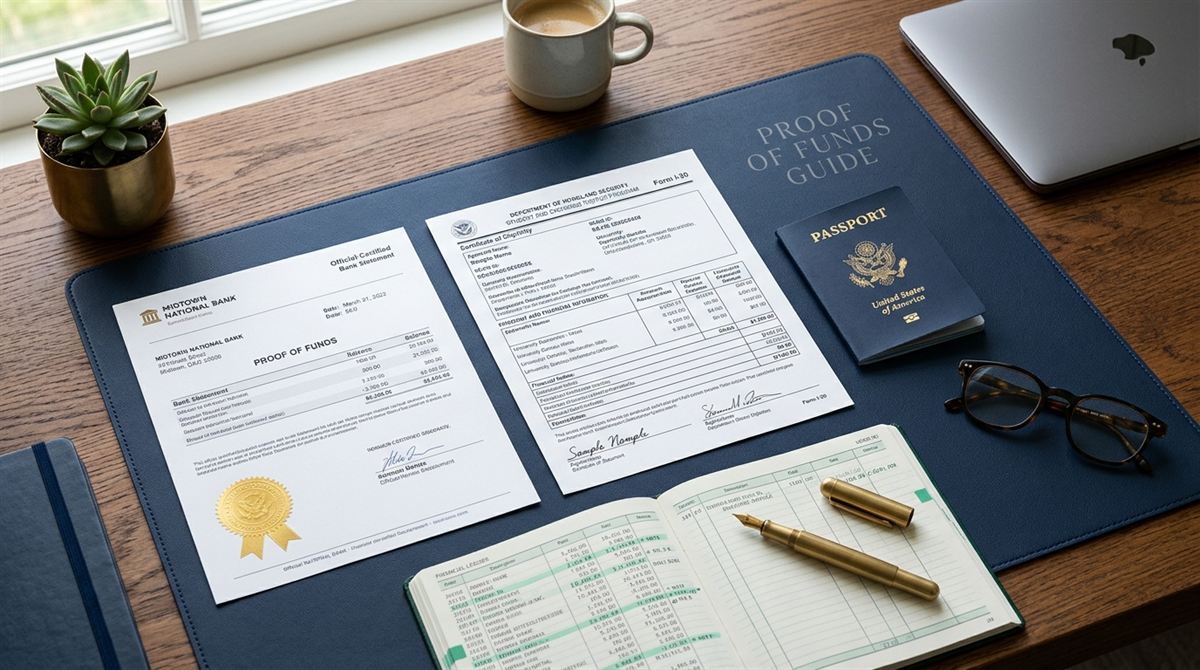
Published by the AcademicZed Editorial & Research Team | Verified for 2026 Consular Regulations
Under U.S. federal immigration law (22 CFR § 41.61(b)(1)(ii)), an applicant for an F-1 student visa must demonstrate that they have sufficient, immediately available, and verifiable funds to defray all tuition and living expenses for the entire first academic year, alongside realistic arrangements for covering subsequent years without resorting to unauthorized employment. Failing to prove the legal origin (“provenance”) and liquid availability of your funds is the second most common trigger for refusals under Section 214(b) of the Immigration and Nationality Act (INA).
Table of Contents
Key Takeaways from the AcademicZed Visa Intelligence Desk
- The 1.5x Rule of Thumb: While Form I-20 lists the minimum first-year estimated expense (e.g. $42,000), our research team advises showing at least 1.5 times this amount in liquid funds (savings accounts, fixed deposits, or sanctioned loans) to provide a comfortable buffer against exchange rate volatility.
- Sanctioned Education Loans Are Gold: A formal, non-collateral or collateral-backed loan sanction letter from a recognized national bank is the cleanest financial proof because it completely eliminates suspicions of temporary “fund parking.”
- Liquid vs. Non-Liquid Distinction: Real estate property valuations, agricultural land, gold jewelry, and unvested retirement funds cannot be counted toward Year 1 liquid maintenance; they only serve as secondary evidence of long-term family wealth.
- 6-Month Statement Seasoning: Never deposit large sums of unverified cash into your account weeks before your visa interview. Any single transaction exceeding $2,000 must be traceable to a legitimate commercial transaction, tax refund, or asset liquidation.
Acceptable vs. Unacceptable Financial Proof for Form I-20 & Visa
Consular officers categorize financial evidence into primary liquid instruments (immediately spendable) and non-liquid supplementary assets. The table below outlines how consular desks classify asset types:
| Asset Category | Consular Classification | Required Supporting Evidence |
|---|---|---|
| Personal / Family Savings Account | Primary Liquid (100% Accepted) | Official bank certificate + 6 months of stamped statements showing organic cash flow. |
| Bank Fixed Deposits (FDs / Term Deposits) | Primary Liquid (100% Accepted) | Bank deposit confirmation receipt stating funds can be liquidated prematurely without legal impediment. |
| Sanctioned Education Loan | Primary Liquid (Preferred Standard) | Irrevocable bank sanction letter naming student, course, total loan amount, and disbursement schedule. |
| Provident Funds (EPF / GPF) | Conditionally Liquid | Accepted only if accompanied by an official letter stating withdrawable percentage for education. |
| Mutual Funds / Stock Portfolios | Secondary Liquid | Valuation certificate from a registered chartered accountant; partial liquidation into cash is recommended. |
| Real Estate & Agricultural Land | Non-Liquid (Ties Only) | Cannot pay tuition directly. Used exclusively to prove economic ties under Section 214(b). |
Understanding Form I-20 Section 8: Financial Calculations
On Page 1 of your Form I-20, Section 8 (“Financials”) balances estimated expenses against your designated funding sources:
- Estimated Academic Term Expenses: Combines tuition ($20k?$45k), living expenses ($12k?$18k), dependent costs, and mandatory campus fees.
- Student Funding Breakdown: Records personal funds, family funds, school scholarships, and approved third-party sponsors.
The Golden Rule: The total funding certified on the right side of Section 8 must equal or exceed the total estimated expenses on the left side. For your consular interview, carry verified paper documents mirroring every single dollar recorded on that form.
Sponsor Rules: Parents vs. Third-Party Sponsors
Who funds your education matters just as much as how much money is shown. Consular officers apply a strict hierarchy of trust:
Tier 1: Parents (Mother or Father) & Immediate Family
The highest approval rate. Consular officers readily accept that parents will deploy life savings to finance their children’s education. Required: 3 years of Income Tax Returns (ITR / W-2), employment letters, and bank statements.
Tier 2: Self-Financing (Working Professionals)
Strongly received for graduate students with 2 to 5 years of verifiable engineering, corporate, or healthcare experience. Required: tax returns, salary slips, and bank statements reflecting consistent salary accumulation over time.
Tier 3: Third-Party Sponsors (Uncles, Aunts, Distant Relatives)
High-risk category. Consular officers frequently question why a distant relative would commit ,000 to ,000 for your studies. If using a third-party sponsor, you must provide a notarized Affidavit of Support (Form I-134 for US sponsors), evidence of their financial abundance, and a compelling explanation of your close family relationship.
How to Proactively Neutralize the “Fund Parking” Refusal Trap
Consular fraud prevention units review bank statement patterns with meticulous care. “Fund parking” refers to borrowing money from friends or informal lenders to temporarily artificially inflate a bank balance prior to the visa interview.
How to Legitimize Recent Deposits: If you recently liquidated legitimate family assets (such as selling commercial land, withdrawing a provident fund, or closing a long-term mutual fund), attach the exact commercial trail: sale deed, tax deduction certificate, or fund redemption receipt.
Frequently Asked Questions (FAQs)
How much total money should I show in my bank account for an F-1 visa?
You must show at least 100 percent of the total first-year expense figure printed on Section 8 of your Form I-20 in immediately liquid funds (e.g. $40,000 if your I-20 says $40,000). However, the AcademicZed team strongly advises showing 1.5 times the I-20 requirement (e.g. $60,000) through a mix of liquid savings and an education loan to demonstrate financial stability.
Are bank statements older than 3 months accepted by the consulate?
No. Bank balance certificates and account statements should be issued within 14 to 30 calendar days of your scheduled visa interview. Stale statements older than 90 days are routinely rejected because they do not reflect your sponsor’s current financial liquidity.
Can an uncle or relative living in the USA sponsor my student visa?
Yes, but it carries higher scrutiny under Section 214(b). If an American relative sponsors you, they must submit Form I-134 (Affidavit of Support), their latest US Federal Tax Return (Form 1040 / W-2), and you must be prepared to articulate why they are funding your degree instead of your immediate parents.
Is an education loan sanction letter better than showing cash in a bank?
Yes. For consular officers, an education loan from a national bank is one of the highest-trust documents because the bank has already conducted rigorous underwriting on your family’s credit and repayment capability, proving that the money is real and guaranteed for tuition disbursement.
Can I show mutual funds or stocks for my US student visa?
Consulates accept mutual funds and stock investments as secondary proof, provided you present an official valuation report from a registered financial advisor. However, we strongly recommend liquidating the required first-year tuition portion into a standard savings account or fixed deposit prior to the visa interview.
