
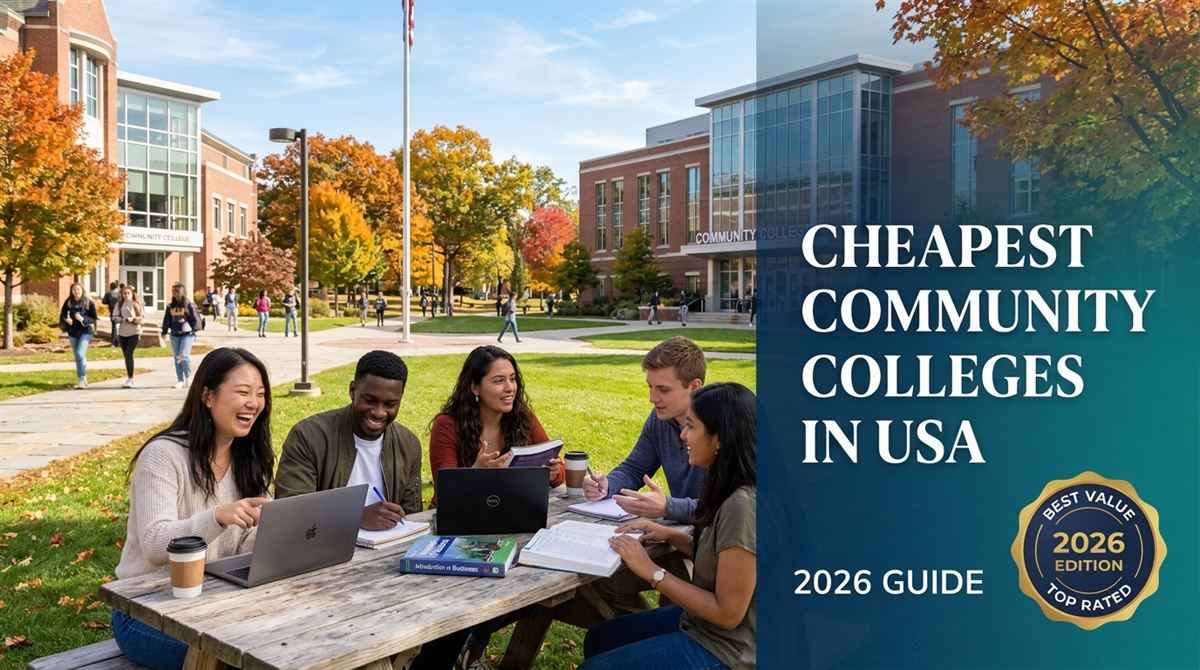
Published by the AcademicZed Editorial & Research Team | Verified for 2026 Admissions
The “2+2 Transfer Pathway” is widely considered the smartest financial strategy in American higher education. By completing your first two years (freshman and sophomore general education courses) at an accredited American community college before transferring into a major four-year public university for your junior and senior years, you earn the exact same accredited Bachelor’s degree diploma while slashing your overall four-year tuition expense by 50 to 70 percent. Dozens of premier U.S. community colleges offer open enrollment, test-optional admissions, and tuition rates between $4,000 and $7,500 per academic year.
Table of Contents
Key Takeaways from the AcademicZed Admissions Advisory Desk
- Substantial Tuition Savings: While four-year public universities charge non-residents $25,000 to $45,000 annually, leading community colleges in Texas, Florida, and Iowa charge international students under $6,000 per year.
- Transfer Admission Guarantees (TAG): Many community colleges maintain formal legal contracts guaranteeing junior-year transfer admission into prestigious institutions such as UC Santa Barbara, UC Davis, Texas A&M, and George Mason University.
- Identical Final Degree Diploma: When you transfer and graduate from a four-year university, your degree certificate and transcript are issued exclusively by the four-year university, with zero distinction from students who attended all four years.
- Simplified Visa Proof of Funds: Because tuition is so low, your Form I-20 financial requirement drops to $15,000 to $18,000 per year, making consular financial clearance substantially easier to obtain.
Comparison Matrix: Top 10 Cheapest US Community Colleges (2026)
The table below summarizes tuition rates, campus location, regional accreditation, and primary university transfer partners:
| Community College | State | Annual Non-Resident Tuition | Primary 2+2 Transfer Partner |
|---|---|---|---|
| 1. South Texas College | Texas | $4,200 | UT Rio Grande Valley, Texas A&M |
| 2. Houston Community College | Texas | $4,800 | University of Houston, UT Austin |
| 3. Dallas College | Texas | $5,200 | UT Dallas, University of North Texas |
| 4. Kirkwood Community College | Iowa | $6,100 | University of Iowa, Iowa State |
| 5. Hillsborough Community College | Florida | $6,800 | University of South Florida (USF) |
| 6. Valencia College | Florida | $7,400 | DirectConnect to Univ. of Central Florida |
| 7. Northern Virginia Community College (NOVA) | Virginia | $8,400 | ADVANCE to George Mason, UVA |
| 8. Santa Barbara City College (SBCC) | California | $8,800 | UC Santa Barbara, UCLA, UC Berkeley |
| 9. De Anza & Foothill College | California | $8,900 | UC Berkeley, Stanford, San Jose State |
| 10. Seattle Colleges (Central/North/South) | Washington | $9,200 | University of Washington, Seattle Univ. |
How the 2+2 Transfer Admission Guarantee (TAG) Works
A Transfer Admission Guarantee (TAG) is an official legal contract between a community college and participating four-year universities. Under TAG agreements:
- You enroll in an Associate of Arts (AA) or Associate of Science (AS) transfer track.
- You maintain a specific cumulative GPA (typically 2.8 to 3.4 depending on your major).
- You complete required general education and major prerequisite courses within 60 transferable credits.
- Upon reaching 60 credits, your junior-year admission into the partner university is 100% guaranteed—bypassing standard competitive freshman admissions.
Navigating Your F-1 Visa Interview for a Community College
Consular officers scrutinize community college applicants closely to ensure the student understands why they chose a two-year institution over a four-year university.
Frequently Asked Questions (FAQs)
Can an international student get an F-1 visa for a community college?
Yes. All accredited community colleges listed in this guide are SEVP-certified and authorized by the U.S. Department of Homeland Security to issue Form I-20 for full-time Associate degree study.
Will my final Bachelor’s degree state that I went to a community college?
No. When you transfer to a four-year institution (such as UCLA, UT Austin, or George Mason) and complete your upper-division coursework, your diploma is awarded solely by that four-year university, exactly identical to that of four-year direct entrants.
Do community colleges have on-campus housing or dorms?
While some community colleges are commuter schools, many institutions with active international enrollments (such as Kirkwood, Hillsborough, and Santa Barbara City College) feature dedicated modern residence halls or affiliated student apartment complexes adjacent to campus.
Can I work while enrolled at a community college?
Yes. Enrolled F-1 students can work up to 20 hours per week in campus bookstores, tutoring labs, dining halls, or student centers, earning $11 to $16 per hour to help offset everyday living expenses.
Do community colleges require SAT or ACT scores?
No. Virtually all U.S. community colleges operate on an open-door admissions policy that does not require SAT or ACT examinations. You only need to submit high school transcripts and proof of English proficiency (or take an on-campus placement assessment).
