
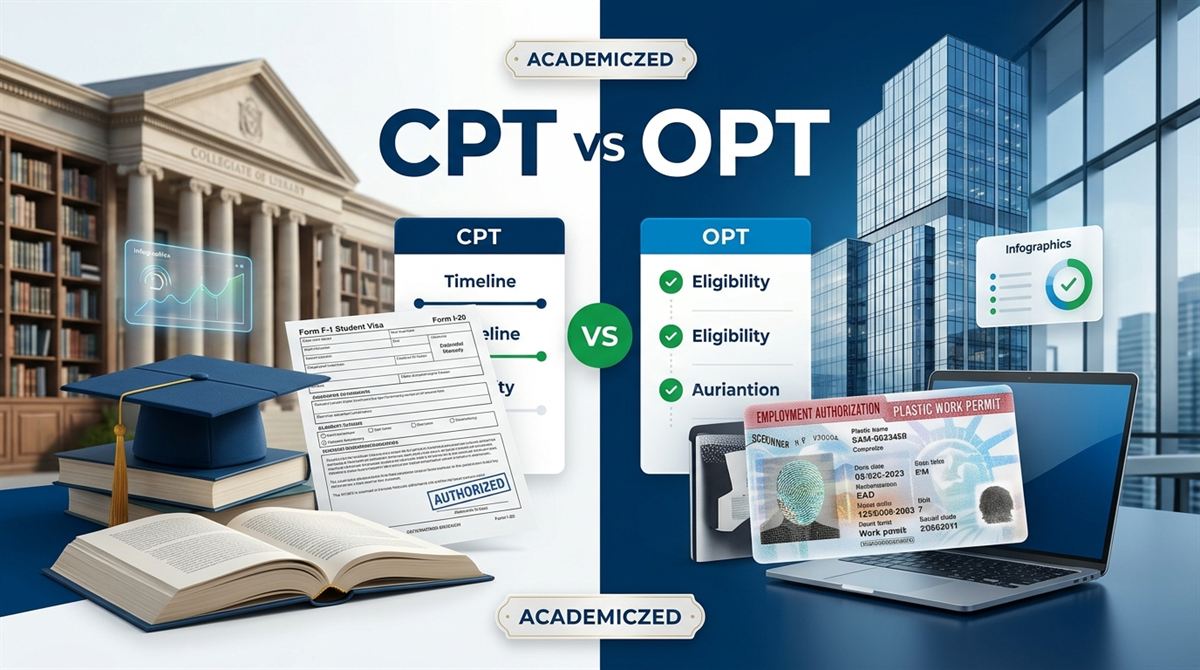
Published by the AcademicZed Editorial & Research Team | Verified for 2026 USCIS Rules
For international students holding an F-1 visa, understanding the legal distinction between Curricular Practical Training (CPT) and Optional Practical Training (OPT) is critical for building a career in the United States while safeguarding your immigration status. While both mechanisms authorize off-campus employment under 8 CFR § 214.2(f)(10), they operate on fundamentally different timelines, fee structures, application workflows, and long-term consequences for your future post-graduate work eligibility.
Table of Contents
Key Takeaways from the AcademicZed Legal Advisory Desk
- Internal vs. Federal Adjudication: CPT is approved directly by your university Designated School Official (DSO) via an updated Form I-20 at zero government cost within days, whereas OPT requires formal federal adjudication by USCIS, an Employment Authorization Document (EAD), and a $470 filing fee.
- Curricular Requirement: CPT must be an integral component of your established academic curriculum (tied to an accredited internship or practicum course), while OPT can be utilized independently before or after degree completion.
- The 365-Day Full-Time CPT Cliff: Accumulating 12 months (365 days) or more of full-time CPT completely eliminates your eligibility for post-completion OPT. Maintaining part-time CPT (20 hours or fewer per week) has zero penalty on OPT.
- Employer Specificity: CPT is strictly tied to a single employer named on your Form I-20; working for any other company without prior DSO authorization constitutes illegal employment. OPT provides open, nationwide employment authorization within your field of study.
Comparison Matrix: CPT vs. OPT for F-1 Students
The table below provides a comprehensive legal side-by-side comparison of CPT and OPT:
| Feature | Curricular Practical Training (CPT) | Optional Practical Training (OPT) |
|---|---|---|
| Approving Authority | University DSO only | USCIS (Federal Government) |
| Authorization Document | Form I-20 page 2 endorsement | Form I-766 (EAD Card) |
| Government Filing Fee | $0 (Free) | $470 USCIS online fee |
| Academic Credit Required | Yes (Mandatory course registration) | No (Extracurricular / post-grad) |
| Job Offer Required Prior to Approval | Yes (Signed employer letter mandatory) | No (Can apply without an offer) |
| Impact on Future OPT | 12+ months full-time cancels OPT | Standard 12 months (+24 mo STEM) |
The 365-Day Full-Time CPT Rule Explained
Under 8 CFR § 214.2(f)(10)(i), international students who accrue one year (365 days) or more of full-time CPT become completely ineligible for post-completion OPT. To preserve your full 12 months of post-completion OPT (and subsequent 24-month STEM extension):
- Track Your Full-Time Days: Never let full-time CPT (more than 20 hours/week) exceed 364 total cumulative days during your degree program.
- Leverage Part-Time CPT: Part-time CPT (20 hours or fewer per week) does not deduct from your post-completion OPT allowance, regardless of how many months you utilize it.
Frequently Asked Questions (FAQs)
When am I first eligible to apply for CPT?
Under federal regulations, international students must have completed one full academic year (two consecutive semesters or three quarters) of full-time study in lawful F-1 status before becoming eligible for CPT, unless enrolled in a graduate program that formally mandates immediate practicum training from Day 1.
Can I work full-time on CPT during school semesters?
Generally, universities limit CPT during active academic terms to part-time (up to 20 hours per week) to ensure academic progress. Full-time CPT (over 20 hours per week) is typically authorized during official university breaks (summer and winter vacations) or under specialized executive graduate curriculums.
Does part-time CPT reduce my 12 months of post-completion OPT?
No. Only full-time CPT (more than 20 hours per week) counts toward the 12-month limit that forfeits OPT. You can participate in part-time CPT for multiple semesters without reducing your future OPT allowance by even a single day.
Can I change employers while authorized on CPT?
You cannot simply change jobs without prior approval. Because CPT is employer-specific, you must submit a new job offer letter, execute a new CPT agreement, and receive an updated Form I-20 with the new employer named on page 2 before starting work at the new company.
Can I work on OPT while an H-1B change of status petition is pending?
Yes, through the “Cap-Gap Extension” under 8 CFR § 214.2(f)(5)(vi). If your employer files an H-1B cap-subject petition with a requested October 1st start date before your OPT expires, your F-1 status and work authorization are automatically extended until October 1st.
